I don’t know if it’s just me getting older, or if Diwali has genuinely changed over the years.
But something about the festival doesn’t feel the way it used to.
The lights are brighter, the sweets are easier to get, the firecrackers come in every colour imaginable, and almost everything we need is available at the click of a button.
And yet, sometimes, I miss the Diwali we used to celebrate.
Not because everything was perfect back then. Quite the opposite. A lot of it was tiring, messy, and occasionally frustrating. But that’s probably what made it memorable.
Remember the Diwali Cleaning?
Diwali cleaning was practically an event in itself.
The entire house had to be cleaned. Cupboards were opened, things we hadn’t seen in months suddenly appeared, and every corner had to be taken care of. It wasn’t a quick call to the house help or a convenient booking on Urban Company.
We did a lot of it ourselves.
There was always something left to clean, something to rearrange, and someone asking why an old item was being thrown away. The preparation could take days, and by the time the house was finally ready, we were probably exhausted.
Today, we have more convenient ways to get things done. And honestly, there’s nothing wrong with that.
But I sometimes wonder if we miss the experience of preparing our homes for the festival together, not just the satisfaction of seeing a clean house.
The cleaning wasn’t Diwali itself, of course. But it was part of the build-up. You knew the festival was approaching because the entire house was slowly transforming.
The Smell of Homemade Diwali Snacks
This one hits differently.
Remember when preparing Diwali snacks and sweets meant spending days in the kitchen?
Chakli, shakarpara, karanji, ladoos, chivda, anarse, and all those other homemade treats that varied from household to household.
There was preparation, frying, cooling, storing, and, naturally, sneaking a taste before everything was ready.
The kitchen would be busy for hours. Recipes were passed around, someone would insist that their version was the best, and the first batch would inevitably become the unofficial quality test.
Today, we can order sweets online and have them delivered home in no time. We can walk into a sweet shop and choose from an incredible variety. We can save ourselves hours of work, and sometimes that’s exactly what we need.
But there’s something different about eating a sweet made at home, knowing how much time and effort went into it.
It wasn’t always about how perfect the chakli looked or whether the shakarpara had the right amount of sweetness. It was about the process, the people involved, and the feeling that the festival was being made at home, quite literally.
Now, we can get almost everything delivered.
Convenient? Absolutely.
The same experience? Not quite.
Those Diyas We Sometimes Didn’t Want to Light
Let’s be honest. Lighting diyas wasn’t always fun.
There were so many of them to arrange. Oil had to be poured, cotton wicks had to be placed properly, and someone inevitably had to go around relighting the ones that refused to stay lit.
You had to be careful about where you placed them, especially when there were children running around. And just when you thought you were done, you’d notice another corner that could use a little light.
It was a whole exercise.
Today, decorative lights can transform an entire balcony with a switch. LED diyas are convenient, reusable, and don’t require constant attention.
But I still remember the warmth of actual diyas glowing around the house.
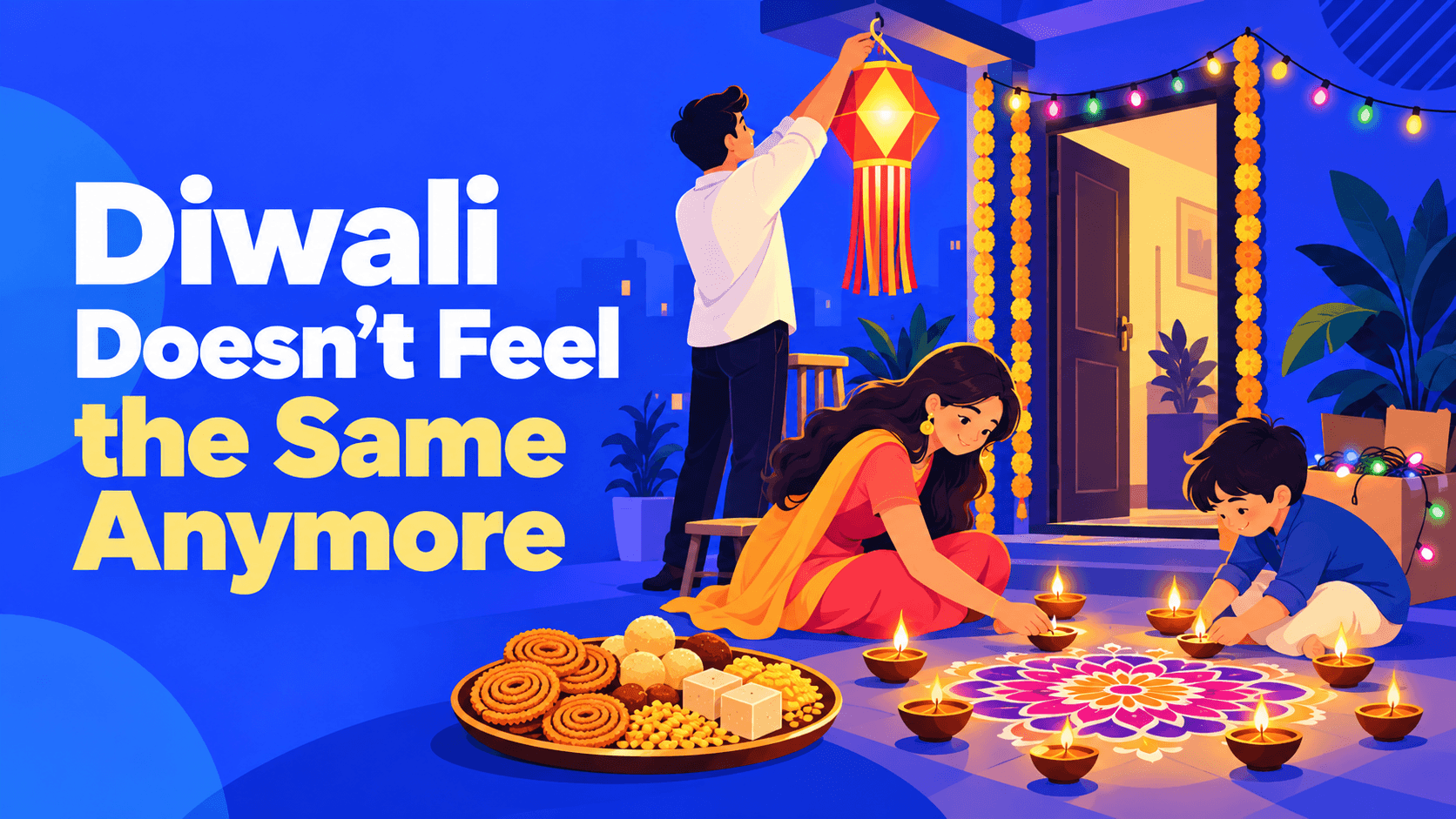
They weren’t perfectly aligned. Some burned brighter than others. A few needed to be adjusted. And there was something satisfying about watching the house come alive, one little flame at a time.
Maybe the charm wasn’t in the diyas themselves. Maybe it was in the time we spent putting them there.
The Rangoli That Never Survived Long Enough
And then there was rangoli.
Hours of effort could go into creating one beautiful design outside the house. Someone would carefully draw the outline, someone else would fill in the colours, and everyone would have an opinion about what needed to be fixed.
You’d finally step back and admire the result.
And then a child would run through it.
Or a neighbour would accidentally pour water nearby.
Or someone would simply walk across it without noticing.
There went your masterpiece.
Annoying? Of course.
But those moments are part of what made the whole thing memorable.
Today, we have ready-made rangoli patterns, stencils, stickers, and all sorts of clever shortcuts. They look neat, take very little time, and save us from the frustration of starting over.
I’m not saying we should abandon them. I’ve seen some beautiful designs made with these options.
I just miss the idea of spending an afternoon making something together, knowing perfectly well that it might not survive until the evening.
The rangoli didn’t have to last forever. The memory did.
Diwali Meant Visiting People, Not Just Wishing Them
Do you remember how Diwali wasn’t complete without visiting friends and family?
We’d dress up, visit relatives, exchange greetings, and sit together for a while. There would be a plate of sweets or faral waiting for us, and we’d happily eat whatever was offered. Sometimes, we’d visit several homes in a single day, and the same conversations would repeat themselves at every stop.
“Have some more.”
“No, no, I’m full.”
“Arre, take it. It’s Diwali!”
And somehow, there was always room for one more chakli or ladoo.
These visits weren’t necessarily planned around elaborate parties or expensive gifts. Sometimes, it was just a quick visit to wish someone a happy Diwali, have a little faral, and catch up with people we hadn’t seen in a while.
Today, a WhatsApp message, a forwarded greeting, or a quick phone call can help us reach everyone. It’s convenient, especially when people live far apart or have packed schedules.
But a message and a visit aren’t quite the same thing.
There’s something about sitting in someone’s home, sharing food, laughing over old stories, and leaving with a box of sweets that makes a festival feel personal.
We may not always have the time to visit everyone anymore. Life has become busier, families have moved to different cities, and our routines have changed.
Still, I wonder when we last visited someone simply because it was Diwali, without needing another reason.
New Clothes Were a Diwali Tradition, Too
Remember shopping for Diwali clothes?
The excitement would start days, sometimes a week or two, before the festival. We’d go shopping, walk through stores, compare options, try things on, and finally come home with something new to wear.
There was a certain anticipation in saving those clothes for the festival. You didn’t necessarily buy something new every other week. For many of us, Diwali was one of those occasions when new clothes felt special.
You’d wait for the right day to wear them, carefully keep them aside, and feel that little excitement when you finally got dressed.
Today, shopping has become almost effortless.
Flipkart, Amazon, Myntra, and countless other platforms have made it possible to browse thousands of options and have something delivered to our doorstep. New clothes are no longer tied to a festival, a birthday, or a special occasion. We can order them almost any month, sometimes without even leaving the sofa.
And there’s nothing wrong with that. Online shopping has opened up choices that weren’t always available to us.
But perhaps that’s part of the difference.
When something becomes available all the time, the anticipation around getting it can fade. A new outfit doesn’t necessarily feel like an event anymore because another one can arrive next week.
Maybe it’s not the clothes we miss. It’s the excitement of waiting for something, knowing exactly when we’d wear it, and associating it with a particular occasion.
Sometimes, having less choice made the choice feel more special.
Those Lanterns and Lights We Brought Out Every Year
And what about the decorations?
I remember the excitement of getting the Diwali lantern out of storage. Somewhere in a cupboard or a box, it had been carefully kept away after the previous year’s celebrations.
We’d bring it out, check whether it was still in good condition, fix whatever needed fixing, and hang it outside the house.
Then came those little blinking decorative lights. We’d untangle the wires, find the right plug, test the bulbs, and figure out which ones were still working.
Some lights would refuse to cooperate. A few bulbs might not glow, and someone would inevitably have to adjust the wire or try another socket.
But once everything was switched on, the house looked different. The lantern hanging outside and those little lights blinking away were enough to tell everyone that Diwali was here.
Today, we have an incredible variety of decorations. Every year brings new designs, new lighting effects, and more options than we could possibly need.
And sometimes, we end up buying new lights even when we already have perfectly good ones at home. The older set gets forgotten, replaced, or doesn’t survive another year.
It’s a little ironic, isn’t it? We have more choices than ever, but sometimes the things we buy don’t even last until the next Diwali.
Back then, bringing out the same lantern and untangling the same old lights was part of the ritual. They weren’t new, but they were familiar. They had been part of previous celebrations, and seeing them again marked the return of the festival.
Perhaps that’s what I miss most about those decorations. Not how they looked, but how they came back into our lives every year.
And Then Came the Firecrackers
Now this is where nostalgia really kicks in.
Today’s firecrackers come in every shape, size, colour, and combination you can imagine. There are elaborate aerial displays, colourful rockets, and fireworks that light up the sky in ways we could only dream of years ago.
But tell me, do you remember the excitement around those Laxmi two-shots and three-shots?
The chakli crackers, the flower pots, and that Green Bomb.
The names alone bring back memories.
There was a particular thrill in knowing which crackers you had bought, figuring out which ones to light first, and waiting for your turn. Some were loud, some were spectacular, and some were simply fun because everyone around you knew exactly what you were talking about.
The Green Bomb had its own reputation. The flower pot was a familiar favourite. And those Laxmi shots had a charm that had very little to do with how sophisticated they were.
It wasn’t necessarily about having the biggest or most expensive fireworks display.
It was about the anticipation. The neighbourhood noise. The excitement of comparing what everyone had bought. The feeling that the entire street was celebrating together.
Of course, we also understand things differently today. Air pollution, noise, safety, and the impact on animals are important considerations. Nostalgia doesn’t mean we have to repeat everything exactly as it was.
But remembering those simpler crackers isn’t really about wanting more noise or bigger explosions.
It’s about remembering how easily a few ordinary things could make us happy.
Have We Outsourced the Festival, Too?
Here’s what I find interesting about all this.
Almost everything that once required our time and effort can now be done faster.
We can get the house cleaned professionally. We can order sweets and snacks. We can decorate with ready-made lights, use rangoli stencils, and find a hundred ideas online before we’ve even decided what we want to do.
These are good things. They make life easier, particularly when people have demanding jobs, family responsibilities, or simply don’t have the time to do everything themselves.
I don’t think the answer is to go backwards.
But I do wonder if, in making everything more convenient, we’ve sometimes removed the very activities that made the festival feel special.
We used to spend time preparing for Diwali. Now, we can arrange much of it with a few bookings and deliveries.
We used to make things together. Now, we can buy them ready-made.
We used to spend hours decorating. Now, we can get a similar result in minutes.
And somewhere between all that convenience, I wonder if we’ve lost a little of the anticipation.
Perhaps the festival hasn’t become less meaningful. Perhaps the way we experience it has changed.
And perhaps that’s worth thinking about.
Maybe We Don’t Need the Old Diwali Back
I’m not suggesting we stop using delivery apps, fire our house help, or spend an entire week in the kitchen making sweets.
That would miss the point.
Life has changed. Our responsibilities have changed. The way we live, work, and spend time together has changed, too.
We cannot recreate our childhood simply by buying the same crackers or making the same sweets.
But maybe we can bring a few things back.
Make one batch of chakli or shakarpara at home, even if the rest comes from the sweet shop. Light a few actual diyas instead of relying entirely on decorative lights. Spend an hour making rangoli with the family, even if the design isn’t perfect.
Put the phones away for a while. Visit someone instead of sending only a greeting message. Sit together after the celebrations and talk about something other than work.
None of this needs to become another task on an already exhausting festive checklist.
The idea is not to do everything ourselves. It’s to choose a few things we genuinely enjoy doing together.
Because the real value of a festival was never just in how clean the house looked, how elaborate the decorations were, or how many sweets we had on the table.
It was in the people who helped make it happen.
So, What Does Diwali Mean to Us Now?
Maybe I’m simply growing older. Maybe every generation looks back at its childhood festivals and feels that something has changed.
And maybe the Diwali we remember was special partly because we were younger, had fewer responsibilities, and experienced the world differently.
I can accept that.
But I also believe that traditions are made of little things. The recipes we repeat, the diyas we light, the designs we create, and the stories we tell every year.
When those things disappear, we don’t necessarily lose the festival. But we might lose some of the experiences that helped us connect with it.
So this Diwali, I’m not asking anyone to give up convenience or recreate the past.
I’m just wondering if we can make a little more room for participation, togetherness, and the small, imperfect rituals that make celebrations feel like our own.
Because years from now, I doubt we’ll remember whether the rangoli came from a stencil or whether the sweets were delivered in ten minutes.
We’ll probably remember who was there, who made us laugh, who ruined the rangoli, and who insisted on eating the first chakli before anyone else could.
And perhaps that’s where the magic of Diwali was all along.