There’s something I find interesting about the way we talk about our lives these days.
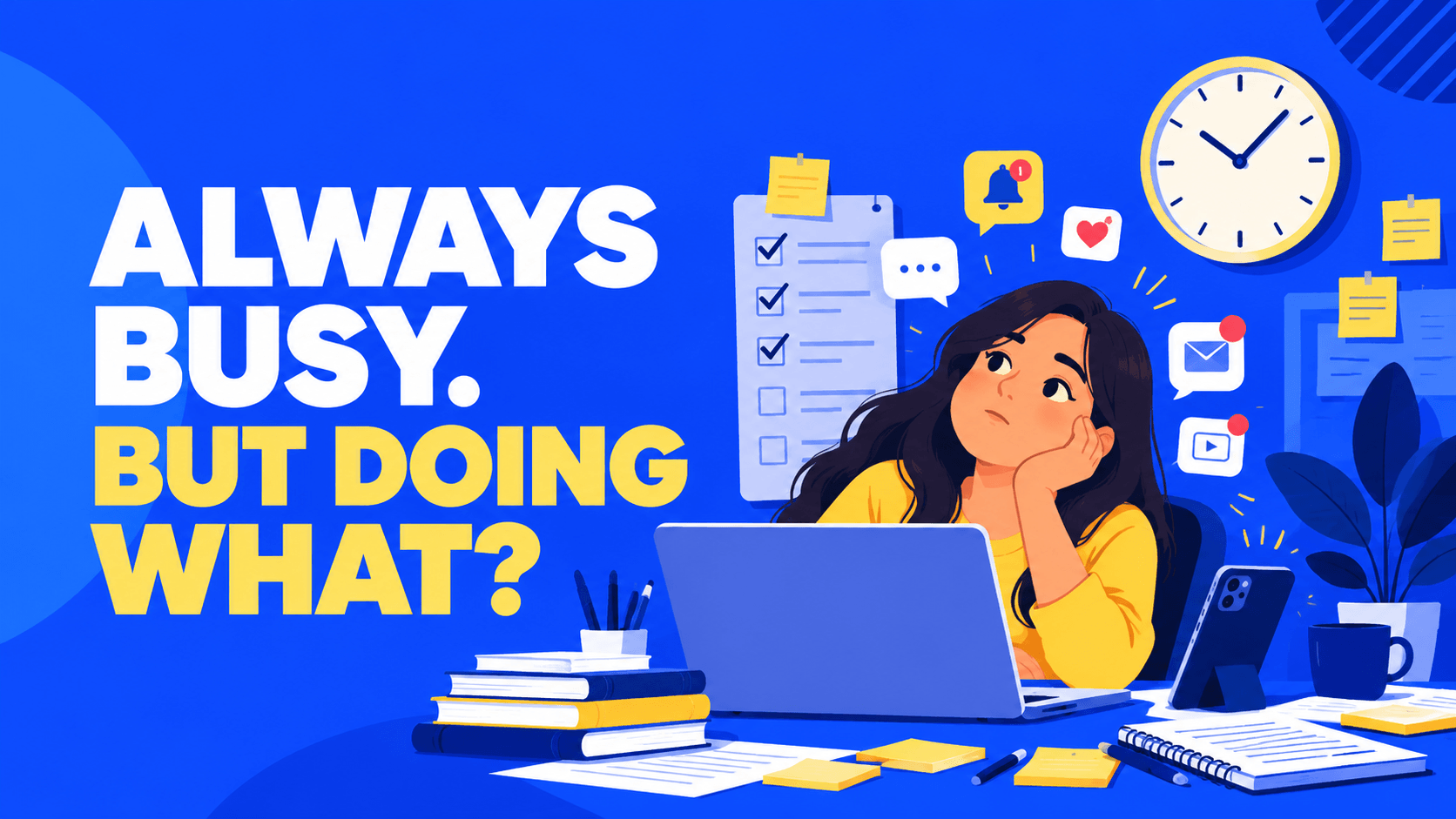
Ask someone how they’re doing, and there’s a good chance you’ll hear, “Busy, yaar. Too much going on.”
Ask them how their week was, and they’ll tell you how many meetings they had, how much work they finished, how many things they had to take care of, and how little time they had for themselves.
I’ve done this myself. We all have our own versions of a busy day.
But every once in a while, I reach the end of a day when I’ve been occupied from morning to night, and I struggle to answer a rather simple question.
What did I actually do today that mattered to me?
Not what I completed. Not how many messages I responded to. Not how many things I crossed off a list.
What made the day feel worthwhile?
I don’t always have a clear answer.
And I suspect I’m not the only one.
Our Days Are Full, But Are They Fulfilling?
Think about a typical working day. You wake up, check your phone, get ready, and start working. There are messages to respond to, meetings to attend, tasks to finish, and unexpected things that demand your attention.
In between, you might scroll through Instagram, check Threads, watch a few YouTube videos, or catch up on what everyone else is doing.
By the time the day ends, you’re tired. You might even feel that you’ve earned a little time to yourself. But before you know it, you’re getting ready for bed, wondering where the evening went.
Then the next day begins, and the cycle repeats.
There’s nothing inherently wrong with any of these activities. Work needs to get done, messages need responses, and there’s nothing wrong with spending time on social media or watching a few videos.
The question is whether we’re making these choices deliberately or simply moving from one thing to another because it’s what’s in front of us.
There’s a difference between having a full day and having a fulfilling one. Unfortunately, it’s quite easy to confuse the two.
We’ve Started Treating Busyness as Progress
Somewhere along the way, being busy became a way of demonstrating that we’re doing something with our lives.
A packed calendar suggests we’re in demand. A long to-do list suggests we’re productive. Being exhausted at the end of the day almost feels like proof that we’ve worked hard enough.
But being occupied and making progress aren’t necessarily the same thing.
You could spend an entire afternoon responding to emails and still avoid the one difficult task that would actually move your work forward. You could spend hours consuming content about fitness, personal growth, or building a business without taking a single step towards any of those goals.
You could even spend your entire weekend preparing to do something you’ve wanted to start for months, only to reach Sunday evening without having started it.
We’ve all probably experienced some version of this.
The problem isn’t that these activities are useless. It’s that they can create the feeling of progress without always producing the progress we were hoping for.
And because we’re doing something all the time, we rarely stop to question whether it’s the right thing.
Perhaps the more useful question isn’t how much we managed to get done today, but whether any of it brought us closer to the things we actually care about.
We Have More Ways to Save Time, Yet We Still Feel Short of It
Think about how much easier everyday life has become.
We can order groceries without visiting a store, get food delivered to our homes, book services online, pay bills in seconds, and shop for almost anything from our phones. Technology has removed a lot of the friction from daily life.
These are genuine improvements. They save time and make many things more accessible.
But here’s what I find interesting: when we save time in one area, we don’t always get more free time in return. We often fill that space with something else.
The extra fifteen minutes become another round of scrolling. The time saved by ordering something online gets absorbed by another task. A free evening becomes an opportunity to catch up on work or squeeze in something we’ve been postponing.
There’s always something else we could be doing.
And our phones make sure there’s never a shortage of things competing for our attention.
A few minutes of scrolling can turn into half an hour. One notification leads to another conversation, which leads to another app, and suddenly the little break we intended to take has become a significant part of our evening.
I’m not suggesting that we need to stop using our phones or reject the conveniences of modern life. That would be an unnecessarily simplistic answer.
But perhaps we should occasionally ask ourselves whether we’re using the time we’ve saved in ways that actually make our lives better.
Because saving time and knowing what to do with it are two very different things.
Even Our Free Time Has Become Another Project
This is something I find particularly interesting.
We’ve become so accustomed to thinking about improvement that we sometimes struggle to let ourselves do things without expecting something in return.
We start exercising, and soon we’re tracking every metric. We pick up a hobby, and before long, we’re wondering whether we could turn it into a side hustle. We start reading, learning, or creating something, and eventually we begin thinking about how to make the most of it.
There’s nothing wrong with having goals. I enjoy working towards mine, too.
But does everything we do need to lead somewhere?
Can’t we go for a walk simply because it feels good to get outside? Can we watch a film without feeling that we should have used those two hours to learn something? Can we spend an evening doing absolutely nothing productive without treating it as wasted time?
I think we’ve become so accustomed to optimising our lives that we sometimes forget to experience them.
Not every interest needs to become an achievement. Not every hour needs to be accounted for. And not every activity needs to make us better at something.
Sometimes, the value is in doing the thing itself.
What Are We Leaving Out While We’re Busy?
Here’s where I think this becomes more than a conversation about productivity.
When we’re constantly occupied, the things that matter to us don’t necessarily disappear. They simply get pushed to the edges of our lives.
We tell ourselves we’ll call that friend when work settles down. We’ll spend more time with family after this busy period. We’ll return to that personal project when things become less hectic. We’ll finally take a break once we’ve caught up on everything.
The trouble is that life rarely stays quiet for long enough for all those plans to fall into place.
There’s always another deadline, another responsibility, another thing that needs attention.
And while we’re waiting for the right time, days turn into weeks and weeks turn into months.
I’m not saying that we should abandon our responsibilities or pretend that everyone has the same amount of freedom over their schedules. Work, family, finances, and other obligations are real, and not everything can be rearranged simply because we want more time.
But perhaps there’s a difference between genuinely not having the time and never getting around to making room for something.
It’s worth asking ourselves which of those situations we’re in.
Because if something matters to us, we probably don’t want it to remain on a permanent waiting list.
So, What Would a Good Day Look Like?
I don’t think the answer is to create a better routine, wake up earlier, or squeeze more activities into an already packed schedule.
Those things might work for some people, but they don’t address the question I’m trying to get at.
What if we stopped measuring a good day purely by how much we accomplished?
Maybe a good day is one where we made meaningful progress on something important, even if we didn’t finish everything else.
Maybe it’s a day when we were fully present during a conversation instead of checking our phones between sentences. Or when we spent time with family without mentally running through tomorrow’s workload.
Maybe it’s finally making a start on something we’ve been putting off, taking a proper break without feeling guilty, or simply going to bed without the nagging feeling that we spent the entire day reacting to everyone else’s priorities.
And some days, a good day might just be an ordinary one. Nothing particularly exciting happens, but we have enough space to enjoy the little things without constantly thinking about what comes next.
I don’t think there’s one universal definition of a good day. It will look different for each of us, depending on our circumstances and what matters to us at that particular point in life.
But I do think it’s worth having our own definition, rather than automatically assuming that a productive day is a successful one.
Maybe We Don’t Need to Do More
I still have plenty of things I want to do. There are ideas I’d like to explore, projects I’d like to work on, skills I’d like to develop, and experiences I’d like to make time for.
I don’t expect that list to get shorter anytime soon.
But I’ve started thinking that the goal shouldn’t be to fit everything into my life. Perhaps it’s to become a little more deliberate about what gets a place in it.
Some things deserve our attention. Others are simply distractions that happen to be available. And some things are perfectly enjoyable in moderation but don’t need to occupy as much of our time as they sometimes do.
The challenge is recognising the difference.
We don’t have to turn every spare moment into an opportunity. We don’t need to say yes to every interesting idea. And we don’t have to feel guilty when we choose to do less.
Maybe we need to get comfortable with leaving a few things unfinished so that we can give our attention to the things we’d rather not miss.
Because the days will keep passing, whether our to-do lists are complete or not.
And I would rather look back at an ordinary Tuesday and remember a conversation I enjoyed, something meaningful I worked on, or an hour I spent doing something I love than remember only how busy I was.
So the next time someone asks how your day went, perhaps ask yourself one more question before answering.
Not just, “How much did I get done?”
But, “Was any of that how I actually wanted to spend my day?”
It’s a small question, but I think it’s worth asking.
We’re going to be busy anyway. Perhaps it’s time to be a little more intentional about what we’re busy doing.