There are devotional songs that make you want to close your eyes and pray.
And then there are songs that make you smile first — before you realise that there is actually a beautiful story hidden underneath them.
“Parvati” from Hanuman Ansh is one of those songs.
Written, composed, and sung by Sadhu Tiwari, the song has caught people’s attention with its rustic Bundeli language, playful storytelling, and an unusually relatable way of narrating the story of Shiva and Parvati.
The most recognisable line is:
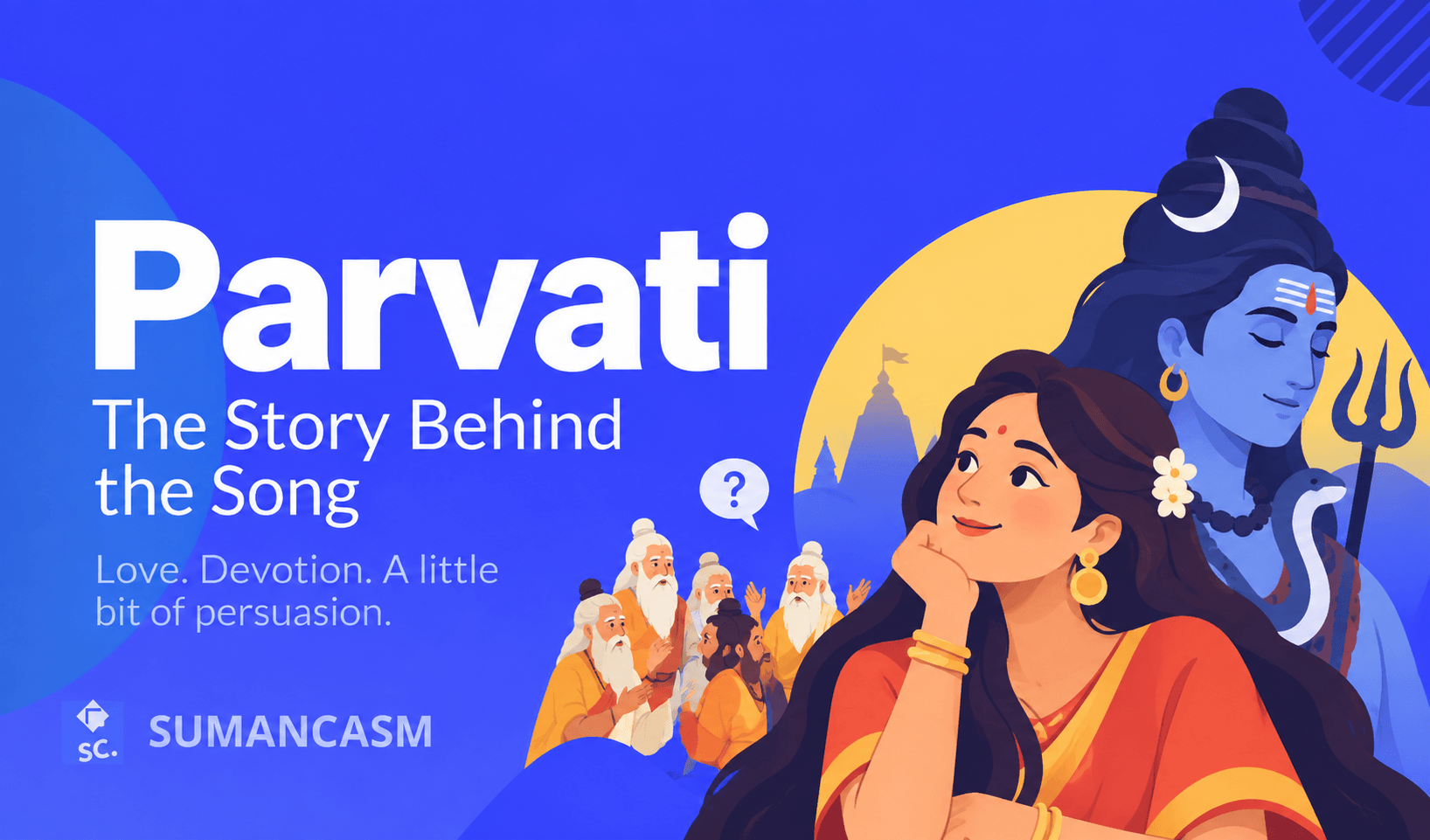
“Jab zid pe aa gayi Parvati, samjhane pahunche Saptarishi.”
In simple Hindi:
जब पार्वती भगवान शिव को ही अपना वर चुनने पर अड़ गईं, तो उन्हें समझाने सप्तऋषि पहुंच गए।
And that is where the fun begins.
What is the Parvati song actually about?
The song describes the time when Parvati is determined to marry Lord Shiva and undertakes severe penance for him.
The Saptarishis arrive to convince her to reconsider.
And their argument is almost comical.
They essentially tell her:
Why are you so stubborn? Why are you putting yourself through this for such a groom?
After all, look at Shiva.
He has Ganga flowing from his head and snakes around his neck.
He has matted locks.
He wanders around dressed like an ascetic.
He doesn’t appear particularly interested in conventional household life.
He doesn’t have a fancy house or worldly possessions.
In today’s language, the Saptarishis are almost asking:
“Parvati, are you really sure about this guy?”
And that is precisely what makes the song so charming.
“काय ज़िद कर रही, काय को मर रही?”
One of the phrases that keeps getting repeated is:
“काय ज़िद कर रही, काय को मर रही?”
In Bundeli, “काय” means “why.”
So the Saptarishis are essentially asking:
“Why are you being so stubborn? Why are you putting yourself through so much?”
They cannot understand why Parvati would choose someone who appears so far removed from the conventional idea of an ideal husband.
And the song keeps piling on the reasons.
Shiva has Ganga on his head.
Snakes around his neck.
Jata.
A crescent moon.
The life of an ascetic.
And, as the song puts it, “ghar-grihasthi kya jaane” — what does he even know about household life?
It is almost the ultimate rishta dekhne wale relatives conversation.
Except the groom happens to be Mahadev.
Why does the song sound so different?
This is perhaps my favourite thing about “Parvati.”
It doesn’t sound like a conventional Bollywood devotional song.
There is no need to make the story excessively grand.
Instead, it feels like someone is sitting in a village and telling you an old story.
The Bundeli language gives the song its character.
Words like kाय, मड़इया and other regional expressions make the story feel lived-in rather than scripted. The result is less like listening to a formal religious composition and more like listening to a folk storyteller narrate something that has been passed down for generations.
And perhaps that is why it works.
The story is ancient.
The way it is being told feels completely alive.
The deeper meaning of Parvati’s “zid”
On the surface, the song is funny.
The Saptarishis are listing everything that makes Shiva seem like an unconventional choice.
But underneath that humour is something much deeper.
Parvati doesn’t choose Shiva because he has wealth.
She doesn’t choose him because he looks like a conventional prince.
She doesn’t choose him because he has a beautiful palace or a comfortable lifestyle.
She chooses him despite all of those things.
Her determination comes from devotion and conviction.
Everyone else is looking at Shiva from the outside.
Parvati sees something beyond the appearance.
And that gives the word “zid” an interesting meaning.
Maybe it isn’t stubbornness.
Maybe it is certainty.
There is a difference between refusing to listen to anyone and knowing what you truly want despite everyone else questioning it.
Shiva as the “unlikely groom”
There is also something wonderfully human about the way the song describes Shiva.
Today, when families discuss marriage, there are often endless questions.
What does he do?
Where does he live?
What does his family do?
How much does he earn?
What kind of lifestyle does he have?
Does he have a house?
Does he have a stable career?
The Saptarishis have their own version of the checklist.
Except Shiva fails almost every conventional parameter.
No proper house.
No conventional appearance.
No interest in material comforts.
Snakes around his neck.
Ganga in his hair.
And yet Parvati remains certain.
The humour works because the concerns are surprisingly familiar.
There is more to the story than romance
It would be easy to describe the song simply as a story about Parvati’s love for Shiva.
But there is another layer.
Parvati’s relationship with Shiva is also presented through tapasya, devotion and spiritual determination.
She isn’t simply waiting for Shiva to notice her.
She is willing to undertake the difficult path required to reach him.
That is why the song repeatedly moves between humour and devotion.
One moment you’re laughing at the description of Shiva.
The next, you’re reminded that this is Bholenath.
The man everyone else finds strange is the very person Parvati refuses to give up on.
Why “Parvati” feels refreshing
Perhaps the biggest reason this song stands out is that it doesn’t try too hard.
It doesn’t need complicated lyrics.
It doesn’t need an enormous musical arrangement.
It takes a familiar story, puts it into a regional language, adds folk humour and lets the characters carry the song.
And suddenly, a story that most of us have heard before feels new again.
That’s something Indian folk traditions have always done beautifully.
They don’t necessarily reinvent the story.
They reinvent the way we experience it.
The line that stays with me
For me, the most interesting part isn’t even the description of Shiva.
It is the contrast.
The entire world around Parvati seems to be saying:
“Think again.”
And Parvati is saying, in her own way:
“I already have.”
That is the heart of the song.
Not blindly choosing.
Not ignoring reality.
But having a conviction that is stronger than the opinions surrounding you.
And maybe that’s why this little Bundeli bhajan has connected with so many people.
Because beneath the jokes about Shiva’s appearance, his snakes, his jata and his lack of interest in ghar-grihasthi, there is a timeless story about seeing beyond appearances.
Final thought
The Parvati song from Hanuman Ansh is a lovely reminder that devotional music doesn’t always need to sound solemn.
Sometimes devotion can be playful.
Sometimes mythology can make you laugh.
Sometimes an ancient story becomes more relatable when told in the language of ordinary people.
And sometimes the most unconventional groom in mythology gets the most determined bride of all.
“Jab zid pe aa gayi Parvati…”
Maybe the real question isn’t why Parvati was so stubborn.
Maybe it’s:
What did Parvati see in Shiva that everyone else couldn’t?
And that is what makes this song worth listening to beyond the viral hook.
Har Har Mahadev. 🙏
“Parvati” is from the 2026 film Hanuman Ansh. The song is written, composed and sung by Sadhu Tiwari, with music production by Sadhu Tiwari and Samiran Das.