Introduction
There are times when we turn to prayer not because we have all the answers, but because we need the strength to face what lies ahead.
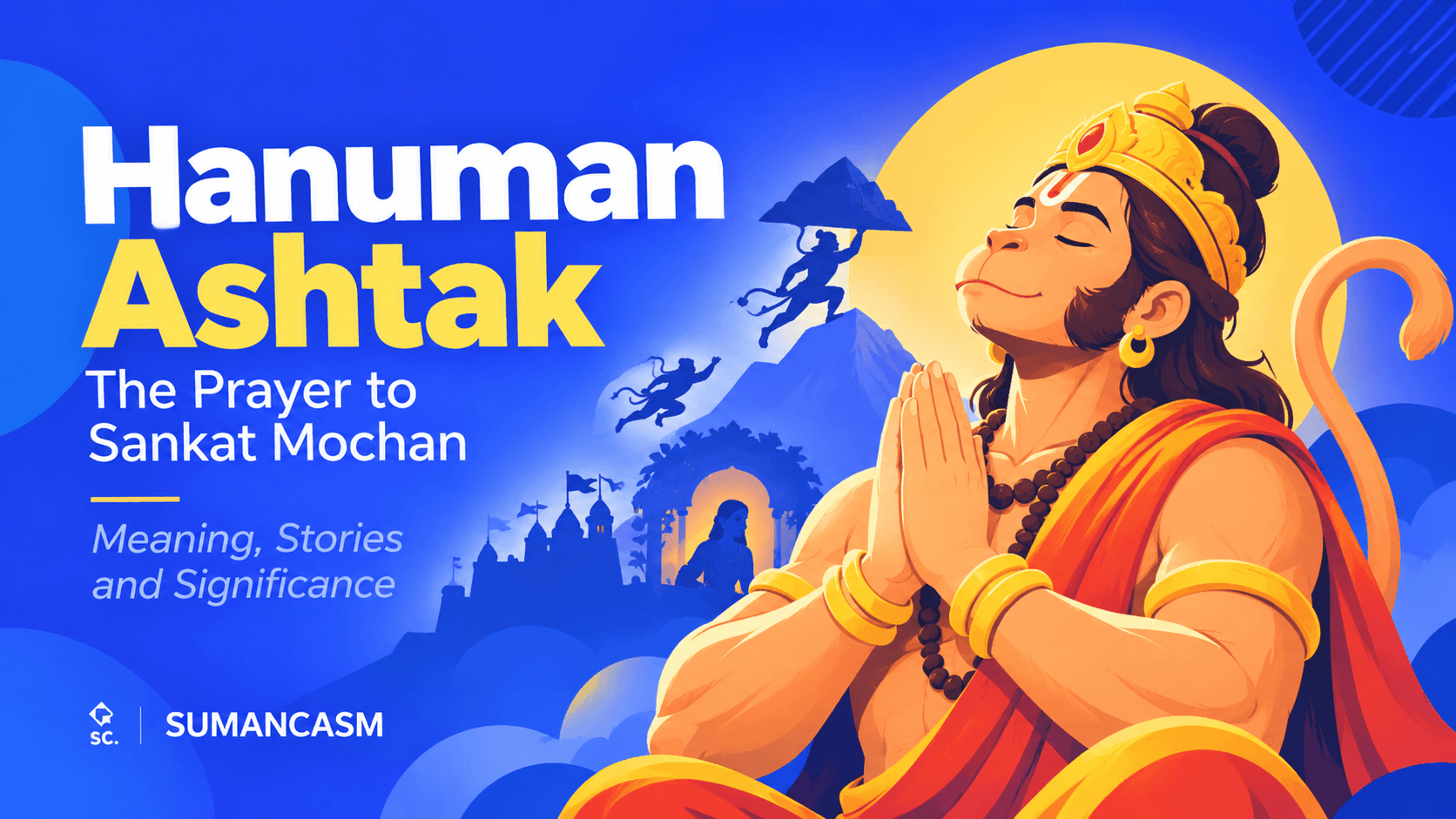
Sankat Mochan Hanuman Ashtak is one such devotional composition dedicated to Lord Hanuman. Through eight verses, it recalls different moments from the Ramayana when Hanuman displayed extraordinary courage, wisdom, devotion, and determination to overcome seemingly impossible situations.
Traditionally attributed to Goswami Tulsidas, this Awadhi composition is often recited by devotees seeking courage, strength, and reassurance during difficult times.
What makes the Hanuman Ashtak particularly meaningful is its structure. Each verse recalls a challenge that Hanuman overcame, while the final verse turns towards the devotee’s own struggles.
In this article, we’ll explore all eight verses, their Hindi lyrics, English transliteration, and simple meanings, along with the significance of chanting this beautiful prayer.
Hanuman Ashtak: Meaning and Significance at a Glance
What is it? Sankat Mochan Hanuman Ashtak is an eight-verse devotional composition dedicated to Lord Hanuman.
Who composed it? It is traditionally attributed to Goswami Tulsidas.
Language: Awadhi.
What does it describe? The eight verses recall important episodes from the Ramayana, highlighting Hanuman’s courage, intelligence, devotion, and ability to overcome difficult situations.
What does Sankat Mochan mean? The remover or liberator from difficulties and distress.
When is it recited? Many devotees recite it on Tuesdays and Saturdays, although personal devotional practices vary.
The composition concludes with a Doha praising Hanuman’s strength, appearance, and divine qualities.
Download Hanuman Ashtak PDF – Free
Want to keep the verses handy for your daily prayers?
We’ve prepared a printable Hanuman Ashtak PDF containing the Hindi verses, English transliteration and simple meanings.
[Download Hanuman Ashtak PDF – Free Printable Copy]
You can save it on your phone or print a copy for easy reading.
What Is Hanuman Ashtak?
Hanuman Ashtak (Sankat Mochan Hanuman Ashtak) is a beloved devotional prayer written by Saint Tulsidas—the same genius behind Hanuman Chalisa. It’s a collection of eight verses (“ashtak” means eight) focusing on Hanuman’s superpowers: courage, devotion, and ability to solve any problem. This prayer is often recited after Hanuman Chalisa, especially on Tuesdays or Saturdays.
Significance of Hanuman Ashtak
The significance of Sankat Mochan Hanuman Ashtak lies in the stories it brings together and the qualities of Lord Hanuman that they represent.
Each verse reminds us of a moment when Hanuman faced a difficult situation and found a way forward. Together, these stories offer several meaningful lessons:
1. Courage in difficult situations
From swallowing the sun as a child to entering Lanka in search of Sita, Hanuman’s stories remind us that courage often means facing situations that initially appear impossible.
2. Wisdom and intelligence
Hanuman’s strength is not limited to physical power. His ability to understand situations, communicate wisely, and make the right decisions is equally important.
3. Unwavering devotion
His dedication to Lord Rama is central to the Ramayana. The Ashtak reminds devotees of the importance of faith, humility, and selfless service.
4. Hope during challenging times
The repeated refrain, “Sankatmochan naam tiharo”, reminds devotees of Hanuman’s role as the remover of distress and offers reassurance during difficult moments.
5. Strength to face our own struggles
The final verse moves beyond the stories of the Ramayana and becomes a personal prayer. It asks Hanuman to extend the same compassion and strength to the devotee facing difficulties today.
For many devotees, reciting the Hanuman Ashtak is a way of finding comfort, focusing their thoughts, and strengthening their faith.
Hanuman Ashtak Verses: Hindi, Transliteration, and Meaning
Verse 1
बाल समय रवि भक्षी लियो तब, तीनहुं लोक भयो अंधियारो।
ताहि सों त्रास भयो जग को, यह संकट काहु सों जात न टारो।
देवन आनि करी बिनती तब, छाड़ी दियो रवि कष्ट निवारो।
को नहीं जानत है जग में कपि, संकटमोचन नाम तिहारो॥ १ ॥
Baala samay ravi bhakshi liyo tab, teenahu loka bhayo andhiyaaro…
Story behind the verse:
As a child, Hanuman mistook the rising sun for a fruit and leapt towards it, eventually swallowing it. This plunged the three worlds into darkness and created distress among the gods.
When the gods approached him and pleaded, Hanuman released the sun, bringing light back to the world.
Meaning:
This verse celebrates Hanuman’s extraordinary childhood strength and the power he possessed even at a young age. It introduces him as Sankat Mochan, the one who can remove seemingly impossible difficulties.
Verse 2
बालि की त्रास कपीस बसैं गिरि, जात महाप्रभु पंथ निहारो।
चौंकि महामुनि साप दियो तब, चाहिए कौन बिचार बिचारो।
कैद्विज रूप लिवाय महाप्रभु, सो तुम दास के सोक निवारो।
को नहीं जानत है जग में कपि, संकटमोचन नाम तिहारो॥ २ ॥
Baali ki traas kapees basai giri, jaat mahaprabhu panth niharo…
Story behind the verse:
Sugriva was living in fear of his brother Bali and had taken refuge on Mount Rishyamukha. When Lord Rama and Lakshmana arrived nearby, Hanuman approached them in the disguise of a Brahmin.
Recognising their identity and understanding their purpose, Hanuman brought them to Sugriva. This meeting eventually led to an alliance between Rama and Sugriva.
Meaning:
This verse highlights Hanuman’s intelligence, humility, and ability to bring the right people together. His wisdom and communication were just as important as his physical strength.
Verse 3
अंगद के संग लेन गए सिय, खोज कपीस यह बैन उचारो।
जीवत ना बचिहौ हम सो जु, बिना सुधि लाये इहाँ पगु धारो।
हेरी थके तट सिन्धु सबे तब, लाए सिया-सुधि प्राण उबारो।
को नहीं जानत है जग में कपि, संकटमोचन नाम तिहारो॥ ३ ॥
Angad ke sang lein gaye siya, khoj kapees yah bain uchaaro…
Story behind the verse:
Hanuman joined Angad and the other Vanaras in the search for Sita. Their search eventually brought them to the seashore, where the group was exhausted and anxious about returning without any news.
Hanuman eventually crossed the ocean, reached Lanka, and discovered Sita in Ashoka Vatika. By bringing back news of her whereabouts, he restored hope to the search party.
Meaning:
This verse reminds us of Hanuman’s determination and willingness to take responsibility when everyone else had lost hope.
Verse 4
रावण त्रास दई सिय को सब, राक्षसी सों कही सोक निवारो।
ताहि समय हनुमान महाप्रभु, जाए महा रजनीचर मारो।
चाहत सीय असोक सों आगि सु, दै प्रभुमुद्रिका सोक निवारो।
को नहीं जानत है जग में कपि, संकटमोचन नाम तिहारो॥ ४ ॥
Raavan traas dayi siya ko sab, raakshasi son kahi sok nivaaro…
Story behind the verse:
After reaching Lanka, Hanuman found Sita in Ashoka Vatika. She was distressed by Ravana’s threats and the pressure being placed on her.
Hanuman approached her with Lord Rama’s ring as proof of his identity and Rama’s message. This gave Sita reassurance that Rama was searching for her and had not abandoned her.
Meaning:
This verse highlights Hanuman’s compassion and his role as a messenger of hope. Sometimes, the greatest help we can offer someone is reassurance that they are not alone.
Verse 5
बान लाग्यो उर लछिमन के तब, प्राण तजे सूत रावन मारो।
लै गृह बैद्य सुषेन समेत, तबै गिरि द्रोण सु बीर उपारो।
आनि सजीवन हाथ दिए तब, लछिमन के तुम प्रान उबारो।
को नहीं जानत है जग में कपि, संकटमोचन नाम तिहारो॥ ५ ॥
Baan lagyo ur lakshiman ke tab, praan taje soot Raavan maaro…
Story behind the verse:
During the battle in Lanka, Lakshmana was critically wounded by Indrajit’s weapon. Lord Rama’s army was deeply distressed.
Hanuman brought the physician Sushena and travelled to the Dronagiri mountain to find the life-restoring herb. Unable to identify the exact herb, he carried the mountain itself back, ensuring that Lakshmana could be treated.
Meaning:
This verse celebrates Hanuman’s determination and resourcefulness. When faced with a difficult task, he did not give up simply because the solution wasn’t immediately clear.
Verse 6
रावन युद्ध अजान कियो तब, नाग कि फांस सबै सिर डारो।
श्रीरघुनाथ समेत सबै दल, मोह भयो यह संकट भारो।
आनि खगेस तबै हनुमान जु, बंधन काटि सुत्रास निवारो।
को नहीं जानत है जग में कपि, संकटमोचन नाम तिहारो॥ ६ ॥
Raavan yudh ajaan kiyo tab, naag ki faans sab sir daaro…
Story behind the verse:
During the battle with Ravana, Rama and members of his army were bound by the Nagapasha, a divine serpent weapon.
Hanuman brought Garuda, the divine eagle and natural enemy of serpents. Garuda’s arrival freed Rama and the others from the bindings.
Meaning:
This verse highlights Hanuman’s ability to seek help and act decisively when faced with a challenge beyond his immediate abilities.
Verse 7
बंधू समेत जबै अहिरावन, लै रघुनाथ पताल सिधारो।
देबिन्हीं पूजि भलि विधि सों बलि, देउ सबै मिलि मन्त्र विचारो।
जाये सहाए भयो तब ही, अहिरावन सैन्य समेत संहारो।
को नहीं जानत है जग में कपि, संकटमोचन नाम तिहारो॥ ७ ॥
Bandhu samet jabai Ahiraavan, lai Raghunath Patala siddhaaro…
Story behind the verse:
In a popular Ramayana tradition, Ahiravana, the ruler of the netherworld, abducted Rama and Lakshmana and took them to Patal for a ritual sacrifice.
Hanuman entered the netherworld, confronted Ahiravana, and defeated him, rescuing both brothers.
Meaning:
This verse celebrates Hanuman’s unwavering devotion and his determination to protect Lord Rama, even when the challenge takes him into unfamiliar and dangerous territory.
Verse 8
काज किये बड़ देवन के तुम, बीर महाप्रभु देखि बिचारो।
कौन सो संकट मोर गरीब को, जो तुमसे नहिं जात है टारो।
बेगि हरो हनुमान महाप्रभु, जो कछु संकट होए हमारो।
को नहीं जानत है जग में कपि, संकटमोचन नाम तिहारो॥ ८ ॥
Kaaj kiye bad devan ke tum, beer mahaprabhu dekhi bichaaro…
Story and meaning:
The final verse shifts from recounting Hanuman’s past achievements to a personal appeal.
The devotee remembers everything Hanuman has accomplished for the gods and asks a simple question: if you could overcome those enormous challenges, what difficulty of mine could be beyond your help?
It is a prayer for strength, protection, and relief from personal struggles.
This final verse brings the entire composition together. The stories of Hanuman’s courage and devotion become a source of hope for the person reciting the Ashtak.
Doha (Final Couplet)
लाल देह लाली लसे, अरु धरि लाल लंगूर।
वज्र देह दानव दलन, जय जय जय कपि सूर॥
Laal deh laali lase, aru dhari laal langoor…
Meaning: Hanuman’s glowing red body and immense strength can defeat even the toughest demons. Victory to Hanuman!
How to Chant Hanuman Ashtak
Hanuman Ashtak can be recited as part of your personal devotional practice. You don’t need to make the process complicated. What matters is approaching the prayer with sincerity and understanding.
Here are a few suggestions:
1. Choose a peaceful time
Many devotees prefer Tuesdays and Saturdays for prayers dedicated to Lord Hanuman. However, you can recite the Ashtak on any day that suits your routine.
2. Find a quiet place
Sit comfortably in a clean and peaceful space. You may choose to sit in front of an image or idol of Lord Hanuman if that is part of your practice.
3. Understand the verses
Rather than simply reading the words, try to understand the stories behind each verse. Knowing what Hanuman accomplished makes the prayer more meaningful.
4. Recite at your own pace
Read each verse slowly and clearly. You can follow the Hindi lyrics and use the English transliteration if you’re unfamiliar with some of the words.
5. Conclude with the Doha
After completing all eight verses, recite the concluding Doha as part of the prayer.
There is no need to rush or turn devotion into a routine of counting repetitions. Make the experience personal and meaningful.
Download Hanuman Ashtak (Hindi + English Meaning) as a Free PDF
Want to chant on the go or share with family? Download our printable Hanuman Ashtak PDF—beautifully formatted with:
- All हिन्दी verses
- Easy English transliteration & meaning
- Simple layout for reading, chanting, or teaching others
No sign-up or ads—just download and use:
➡️ [Download Hanuman Ashtak PDF]
Feel free to print, forward on WhatsApp, or use in your daily prayers—spread positivity!
Frequently Asked Questions About Hanuman Ashtak
1. Who wrote Hanuman Ashtak?
Sankat Mochan Hanuman Ashtak is traditionally attributed to Goswami Tulsidas, the poet-saint also associated with the Hanuman Chalisa and Ramcharitmanas.
2. How many verses are there in Hanuman Ashtak?
Hanuman Ashtak contains eight main verses, followed by a concluding Doha.
3. In which language is Hanuman Ashtak written?
The composition is written in Awadhi, a language associated with the region of Awadh in northern India.
4. What is the meaning of Sankat Mochan?
Sankat means difficulty, distress or trouble, while Mochan means liberation or removal. Sankat Mochan is therefore a name associated with Lord Hanuman as the remover of difficulties.
5. Can Hanuman Ashtak be recited daily?
Yes. Devotees may include Hanuman Ashtak in their daily prayer routine. Others prefer reciting it on Tuesdays, Saturdays or special occasions dedicated to Lord Hanuman.
6. What is the difference between Hanuman Chalisa and Hanuman Ashtak?
Both are devotional compositions dedicated to Lord Hanuman and traditionally attributed to Tulsidas.
The Hanuman Chalisa contains forty verses and praises Hanuman’s qualities, devotion, and achievements. Hanuman Ashtak contains eight main verses, each recalling a particular episode in which Hanuman overcame a difficult situation.
7. How long does it take to recite Hanuman Ashtak?
The time depends on your reading pace. Since it contains eight verses and a concluding Doha, it is generally a short prayer that can be included in a daily devotional routine.
Final Thoughts
Repeat this powerful prayer whenever you need courage or a solution. Share the printable with friends, family, and followers—spread good energy! Hanuman’s story reminds us all: even the biggest problems can be conquered with faith, effort, and a little help from above.