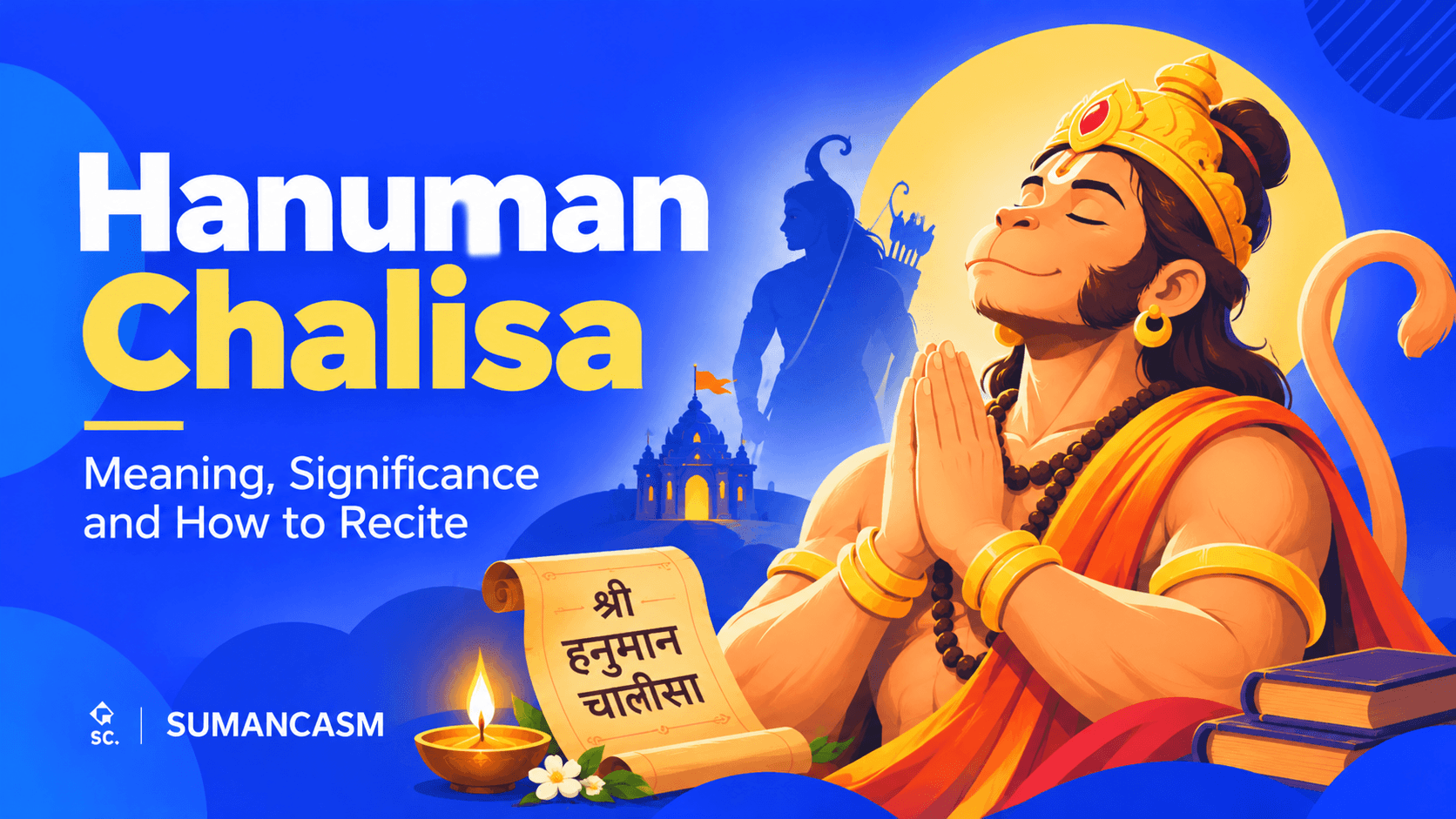
Introduction: Understanding the Hanuman Chalisa
For millions of devotees, the Hanuman Chalisa is more than a prayer. It is a daily expression of faith, devotion, and the search for inner strength.
Written by Goswami Tulsidas in Awadhi, this 40-chaupai devotional composition celebrates the extraordinary qualities of Lord Hanuman: his courage, wisdom, humility, and unwavering devotion to Lord Rama.
But have you ever stopped to understand what you’re actually reciting?
From Hanuman’s childhood encounter with the Sun to his journey to Lanka, the search for Sita and the rescue of Lakshmana, the Hanuman Chalisa brings together some of the most memorable episodes from the Ramayana.
In this guide, we’ll explore the meaning of the Hanuman Chalisa, understand its verses in simple English, discover its significance, and look at how you can incorporate it into your devotional practice.
Whether you’ve been reciting it for years or are reading it for the first time, understanding the words can make the experience much more meaningful.
Hanuman Chalisa: Meaning and Significance at a Glance
Want to read or chant the Hanuman Chalisa offline?
Download the free Sumancasm reading guide with all 40 Chaupais, the opening and closing Dohas, easy pronunciation, and simple English meanings.
📄 Download the Hanuman Chalisa PDF
No sign-up required. Save it, print it, or share it with family.
The Hanuman Chalisa is a devotional hymn dedicated to Lord Hanuman, traditionally attributed to Goswami Tulsidas.
- Composer: Traditionally attributed to Goswami Tulsidas.
- Language: Awadhi.
- Structure: Two introductory Dohas, 40 Chaupais, and one concluding Doha.
- Meaning of Chalisa: Derived from Chalis, meaning forty.
- Central theme: The courage, wisdom, strength, and unwavering devotion of Lord Hanuman.
- Purpose: To praise Hanuman, remember his service to Lord Rama, and seek his blessings.
The Hanuman Chalisa brings together stories from the Ramayana and concludes with a prayer asking Hanuman to reside in the devotee’s heart alongside Lord Rama, Lakshmana and Sita.
What is the Hanuman Chalisa?
The Hanuman Chalisa is a 40-verse hymn dedicated to Lord Hanuman, the mighty monkey god from Indian mythology. Written by poet-saint Tulsidas, it’s recited by millions to seek strength, wisdom, and protection.
- Length: 40 verses (plus an introductory and concluding verse)
- Language: Awadhi (a dialect close to Hindi)
- Purpose: Praise Lord Hanuman’s qualities, ask for his blessings
Think of it as an ancient pep talk combining faith and motivation, recited for centuries by everyone from athletes and students to working professionals.
Significance of Hanuman Chalisa: Why Do People Recite It?
The Hanuman Chalisa has remained an important part of devotional practice for generations. Its popularity comes not only from its praise of Lord Hanuman but also from the stories and values woven into its verses.
Here are some of the reasons devotees find it meaningful.
1. A reminder of courage and strength
Hanuman represents extraordinary physical strength combined with humility and wisdom. His journey reminds devotees that courage is not simply about being powerful; it is also about knowing when and how to use that strength.
2. Devotion and selfless service
One of the central themes of the Hanuman Chalisa is Hanuman’s unwavering devotion to Lord Rama. His actions throughout the Ramayana demonstrate loyalty, humility, and service without expecting anything in return.
3. Faith during difficult times
Many devotees turn to Hanuman Chalisa during periods of uncertainty, fear, or personal difficulties. Its verses offer spiritual reassurance and remind people to approach challenges with courage and faith.
4. Wisdom and control over the mind
The composition repeatedly celebrates Hanuman’s intelligence, knowledge, and ability to act wisely. These qualities are just as important as his physical strength.
5. A connection with the Ramayana
The Chalisa brings together several memorable episodes from the Ramayana, including Hanuman’s search for Sita, his journey to Lanka, and the rescue of Lakshmana.
For many readers, understanding these stories makes the prayer more meaningful than simply reciting its words.
Ultimately, the significance of the Hanuman Chalisa lies in the devotion it expresses and the qualities of Hanuman that devotees seek to remember and embody.
Breaking Down the Meaning
While each verse is rich with symbolism, here’s the essence in everyday language:
- Opening verses: Praise Hanuman’s wisdom, strength, and devotion.
- Middle sections: Describe his heroic acts (like finding Sita, burning Lanka, and carrying the Sanjeevani mountain).
- Closing lines: Seek Hanuman’s blessings for courage, knowledge, and spiritual progress.
A real-life parallel: Imagine having a mentor who’s not only super-strong but also gentle, wise, and always on your side. That’s the vibe the Hanuman Chalisa brings into your life.
Hanuman Chalisa: Verse-by-Verse Simplified Explanation
Introductory Verses
- Shri Guru Charan Saroj Raj / Nij mane mukure sudhar
- I start by seeking blessings from my Guru, so my thoughts are pure and focused.
- (Think: Setting positive intentions before a big meeting or workout.)
- Budhi Hin Tanu Janike / Sumirau Pavan Kumar
- Even if I lack intelligence, I ask Hanuman to give me strength, wisdom, and knowledge.
- (Like asking a mentor for help when you’re overwhelmed.)
The 40 Chaupais: Hanuman Chalisa Lyrics and Meaning
- Jai Hanuman gyan gun sagar / Jai Kapis tihun lok ujagar
- Hail Hanuman, ocean of wisdom and virtue, who illuminates the worlds.
- (A reminder to spread positivity.)
- Ram doot atulit bal dhama / Anjani-putra Pavan sut nama
- You are Ram’s great messenger, son of Anjani and Wind God, full of unmatched strength.
- Mahavir Vikram Bajrangi / Kumati nivar sumati Ke sangi
- Mighty, brave Hanuman, you dispel negativity and bring wisdom.
- (A motivational boost for tough days.)
- Kanchan varan viraj subesa / Kanan Kundal Kunchit Kesa
- Golden-bodied, beautiful Hanuman, with earrings and curly hair.
- Hath Vajra Aur Dhuvaje Viraje / Kandhe moonj janehu sajai
- You carry a thunderbolt and banner, wearing a sacred thread.
- (Always prepared and committed.)
- Sankar suvan kesri Nandan / Tej pratap maha jag vandan
- Relating you to Shiva and celebrating your glory, admired across the universe.
- Vidyavan guni ati chatur / Ram kaj karibe ko aatur
- Highly intelligent and skilled, always eager to serve Lord Ram.
- Prabu charitra sunibe ko rasiya / Ram Lakhan Sita man Basiya
- You love listening to Ram’s stories and have him, Lakshman, and Sita in your heart.
- Sukshma roop dhari Siyahi dikhava / Vikat roop dhari lanka jarava
- You took a tiny form to meet Sita, and a fierce form to burn Lanka.
- (Adapting to situations, like shifting from gentle to assertive as needed.)
- Bhima roop dhari asur sanghare / Ramachandra ke kaj sanvare
- You took a mighty form to defeat demons and fulfill Ram’s tasks.
- Laye Sanjivan Lakhan Jiyaye / Shri Raghuvir Harashi ur laye
- You revived Lakshman with a magical herb, bringing joy to Ram.
- Raghupati Kinhi bahut badai / Tum mam priye Bharat-hi sam bhai
- Ram praised you and considered you as dear as his own brother.
- Sahas badan tumharo yash gaave / Us kahi Shripati kanth lagaave
- Thousands sing your glories; Ram embraces you joyfully.
- Sankadik Brahmadi Muneesa / Narad Sarad sahit Aheesa
- Great sages and deities praise you—even the Creator Brahma and others.
- Yam Kuber Digpal Jahan te / Kavi kovid kahi sake kahan te
- Yama (death god), Kubera (wealth) and all guardians admire you; words fail to match your greatness.
- Tum upkar Sugreevahin keenha / Ram milaye rajpad deenha
- You helped Sugriva meet Ram and gain his kingdom back.
- Tumharo mantra Vibheeshan mana / Lankeshwar Bhaye Sub jag jana
- Vibhishan became King of Lanka by your advice; everyone knows it.
- Yug sahastra jojan par Bhanu / Leelyo tahi madhur phal janu
- You thought the sun was a fruit and leapt to grab it, showing courage and curiosity.
- Prabhu mudrika meli mukh mahee / Jaladhi langhi gaye achraj nahee
- With Ram’s ring in your mouth, you easily crossed the ocean—no surprise for you!
- Durgaam kaj jagat ke jete / Sugam anugraha tumhre tete
- All difficult tasks become easy when you help.
- Ram dware tum rakhvare / Hoat na agya binu paisare
- You guard Ram’s gate; no one enters without your permission—protector mode!
- Sub sukh lahai tumhari sarna / Tum rakshak kahu ko dar na
- All joys come to those who seek your help; with you as protector, there’s no fear.
- Aapan tej samharo aapai / Teenhon lok hank te kanpai
- You control your tremendous power; even the universe trembles at your roar.
- Bhoot pisach Nikat nahin aavai / Mahavir jab naam sunavai
- Evil spirits run away when your name is spoken.
- Nase rog harai sab peera / Japat nirantar Hanumant beera
- All pain and diseases go away by reciting your name regularly.
- Sankat se Hanuman chudavai / Man Karam Vachan dyan jo lavai
- Remembering you in thought, word, and deed removes all troubles.
- Sub par Ram tapasvee raja / Tin ke kaj sakal Tum saja
- All devotees of Ram—you get their work done.
- Aur manorath jo koi lavai / Sohi amit jeevan phal pavai
- Anyone with any wish, if it’s sincere, gets it fulfilled by you.
- Charon Yug partap tumhara / Hai persidh jagat ujiyara
- Your glory shines through all ages and the world.
- Sadhu Sant ke tum Rakhware / Asur nikandan Ram dulhare
- You protect the good, destroy the evil, and are darling to Ram.
- Ashta sidhi nav nidhi ke dhata / Us var deen Janki mata
- You can grant the 8 spiritual powers and 9 treasures—Sita herself gave you this gift.
- Ram rasayan tumhare pasa / Sada raho Raghupati ke dasa
- You hold the elixir of devotion to Ram and always serve him loyally.
- Tumhare bhajan Ram ko pavai / Janam janam ke dukh bisravai
- Through your worship, one gets Ram’s blessings and escapes suffering.
- Anth kaal Raghuvir pur jayee / Jahan janam Hari-Bakht Kahayee
- At life’s end, your true devotees join Ram’s world and are reborn as devotees.
- Aur Devta Chit na dharehi / Hanumanth se hi sarve sukh karehi
- By loving you, there’s no need for other gods—Hanuman brings all happiness.
- Sankat kate mite sab peera / Jo sumirai Hanumat Balbeera
- Recite your name and all sufferings end—simple as that!
- Jai Jai Jai Hanuman Gosahin / Kripa Karahu Gurudev ki nyahin
- Hail Hanuman, master of senses; please bless me like a teacher blesses a student.
- Jo sat bar path kare kohi / Chutehi bandhi maha sukh hohi
- Whoever recites this 100 times gets freedom from trouble and experiences joy.
- Jo yah padhe Hanuman Chalisa / Hoye siddhi sakhi Gaureesa
- Whoever recites the Chalisa receives Hanuman’s blessings—Shiva himself bears witness.
- Tulsidas sada hari chera / Keejai Das Hrdaye mein dera
- Tulsidas, the poet, wishes only to be Ram’s servant, asking Hanuman to reside in his heart.
Concluding Verses
- Pavantnai sankat haran / Mangal murti roop / Ram Lakhan Sita sahit / Hrdaye basahu sur bhoop
- O Hanuman, who removes difficulties and is a source of good, may you dwell in my heart with Ram, Sita, and Lakshman.
Meaning of the Concluding Doha
पवनतनय संकट हरन, मंगल मूरति रूप।
राम लखन सीता सहित, हृदय बसहु सुर भूप॥
English Transliteration
Pavan Tanay Sankat Haran, Mangal Murati Roop,
Ram Lakhan Sita Sahit, Hriday Basahu Sur Bhoop.
Meaning in Simple English
O son of the Wind God, remover of difficulties and embodiment of auspiciousness, please reside in my heart along with Lord Rama, Lakshmana, and Sita.
Significance
The concluding Doha brings the entire Hanuman Chalisa to a beautiful close.
After praising Hanuman’s strength, wisdom, and extraordinary service to Lord Rama, the devotee makes a personal prayer: may Hanuman always remain in the heart, accompanied by Rama, Lakshmana, and Sita.
It reflects the central message of the composition — devotion, humility, and a lifelong connection with the divine.
How to Read and Recite Hanuman Chalisa
The Hanuman Chalisa can be included in your daily devotional practice. Whether you have been reciting it for years or are just beginning, understanding the verses can make the experience more meaningful.
1. Choose a time that works for you
Many devotees prefer Tuesdays and Saturdays for prayers dedicated to Lord Hanuman. Others include the Chalisa in their everyday morning or evening prayers.
There is no need to wait for a particular day to begin.
2. Find a peaceful space
Choose a clean and comfortable place where you can read without distractions. You may sit before an image or idol of Lord Hanuman if that is part of your devotional practice.
3. Understand what you are reciting
If you’re unfamiliar with Awadhi, read the simple meanings alongside the original verses. Understanding the stories behind the Chaupais can make the prayer more engaging.
4. Recite at your own pace
You don’t need to rush through the forty verses. Read slowly, pay attention to the pronunciation and allow yourself time to understand the words.
5. Conclude with the final Doha
Finish the prayer with the concluding Doha, which asks Hanuman to reside in the heart alongside Rama, Lakshmana, and Sita.
Most importantly, make your devotional practice sincere and comfortable rather than treating it as a task to complete.
Take the Hanuman Chalisa Reading Guide with You
The free PDF brings the complete prayer together with easy pronunciation and simple meanings, so you can read at your own pace.
Frequently Asked Questions About Hanuman Chalisa
Who wrote the Hanuman Chalisa?
The Hanuman Chalisa is traditionally attributed to Goswami Tulsidas, the poet-saint also known for composing the Ramcharitmanas.
What does the word Chalisa mean?
Chalisa comes from the Hindi word Chalis, meaning forty. It refers to the forty Chaupais that form the main body of the composition.
In which language is Hanuman Chalisa written?
The Hanuman Chalisa is composed in Awadhi, a language associated with the Awadh region of northern India.
How many verses are there in Hanuman Chalisa?
The commonly published version contains two introductory Dohas, forty Chaupais and one concluding Doha.
Can Hanuman Chalisa be recited every day?
Yes. Many devotees include it in their daily prayers. It is also traditionally recited on Tuesdays and Saturdays.
Why is Hanuman Chalisa recited on Tuesdays and Saturdays?
These days are traditionally associated with Lord Hanuman’s worship. However, devotees can recite the Chalisa on any day.
How long does it take to recite Hanuman Chalisa?
It generally takes around 8–12 minutes, depending on pronunciation and recitation speed.
Can someone who doesn’t know Hindi recite Hanuman Chalisa?
Yes. Readers unfamiliar with Awadhi or Hindi can follow a Roman transliteration and read the English meaning alongside the original verses.
What is the difference between Hanuman Chalisa and Hanuman Ashtak?
Hanuman Chalisa contains forty Chaupais praising Hanuman’s qualities, devotion, and service to Rama. Hanuman Ashtak contains eight main verses that recall specific episodes in which Hanuman overcame difficult situations.
Both are devotional compositions traditionally attributed to Tulsidas.
Continue Your Spiritual Journey
Enjoyed understanding the meaning behind the Hanuman Chalisa? Explore these other devotional stories and prayers from Sumancasm:
- Hanuman Ashtak: Meaning, Significance and Verses – Discover the eight verses of Sankat Mochan Hanuman Ashtak and the stories behind them.
- Parvati Song from Hanuman Ansh: The Story Behind the Song – Explore the story of Parvati’s determination to marry Lord Shiva through a beautiful Bundeli song.
- Is There Just One Ramayana? – Explore the different versions and interpretations of the Ramayana.
Every prayer and story carries something worth understanding. Explore more through our Spiritual Journey collection.
Final Thoughts
The Hanuman Chalisa has been recited across generations, but its significance goes beyond the familiarity of its words.
Every Chaupai offers a glimpse into Hanuman’s extraordinary qualities — his courage, intelligence, humility, and unwavering devotion to Lord Rama.
Understanding these verses allows us to look beyond the familiar recitation and appreciate the stories, values, and devotion behind them.
Perhaps the next time you recite the Hanuman Chalisa, you’ll pause for a moment to understand a verse that you have repeated countless times before.
Because sometimes, knowing what we are reciting makes the prayer even more meaningful.
Jai Hanuman! Jai Bajrangbali!